

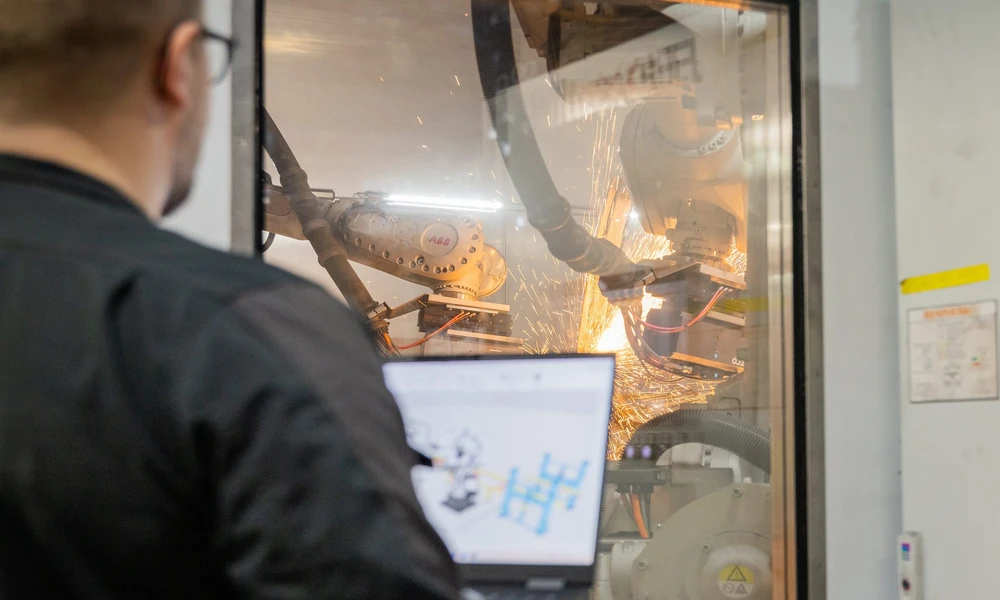
Some robot cells can now be deployed without writing a conventional program instruction by instruction. Instead, application software can ask for workpiece dimensions, machine locations, obstacles and device choices, then use those inputs to configure motion and logic for a supported task. This changes the form of engineering work, but it does not remove the need to define the process accurately or validate the result.
Programming is being replaced by structured specification
Traditional integration requires coordinate systems, waypoints, tool commands, signals and conditional branches to be created explicitly. For common tasks such as machine tending or palletising, much of that logic follows repeatable patterns. A guided interface can therefore ask the user to describe the physical task instead of expressing each step as code. The operator or engineer still makes decisions, but they are made through parameters and application rules rather than an empty programming environment.
The strongest use case is a bounded application
No-code deployment works best when the task has a stable grammar and the supported hardware is known. Machine tending, for example, usually includes loading, machine start, waiting, unloading and placement, while palletising follows product and layer patterns. Application software can turn information about the workspace, workpiece and supported devices into a configured sequence. Its usefulness therefore depends on how closely the real process fits the framework and how clearly the system defines what lies outside it.
No code still requires good input
A graphical workflow cannot correct a badly measured part or an obstacle that was never declared. Users must define pickup references, gripper behaviour, machine signals and reactions to missing material or failed grasps. That can be simpler than editing a large custom program, but the mechanical consequences remain real. Incorrect configuration is still incorrect engineering even when it was entered through menus instead of code.
Generated paths are only the beginning of validation
Software can plan around represented geometry, but the factory also contains flexible cables, loose stock, operator access, machine movement and other conditions that may not exist in a static model. Commissioning therefore requires slow-speed tests, clearance checks and confirmation of boundary behaviour. Safety validation is separate again because the complete application must consider the robot, end effector, workpiece and human interaction, not only whether the calculated path avoids a collision.
Redeployment is where the approach proves its value
The long-term advantage becomes clearer when the same cell has to accommodate new products or production requirements. Instead of rebuilding the application each time, dploy allows changes such as a new box size, part family or pickup position to be handled through controlled parameters within the existing setup. That makes version control and recipe traceability increasingly important, because teams need to know which configuration produced a given batch and be able to restore an earlier state. Easier reconfiguration creates the most value when changes remain structured, documented and repeatable.
Integrators remain part of the picture
Application software can reduce repetitive engineering, but unusual fixtures, machine interfaces, safety design and unstable processes still benefit from specialist knowledge. Internal teams also need a support route for faults that exceed the validated envelope. The practical goal is therefore not to eliminate engineering, but to reserve expert work for the parts of automation that are genuinely specific while making routine deployment and changeover more accessible.
Judge the workflow after the first deployment
The real test of a no-code system comes several months later, when a different operator has to change a product or recover from a fault. A successful platform should make that work understandable without forcing users to reconstruct hidden logic or call a programmer for every routine adjustment. Manufacturers should therefore evaluate not only setup speed, but also traceability, diagnostics, support boundaries and the effort required to revalidate a changed application.
